HR365 - Human Resources Management Solution
TimeSheet 365 - Time recording Solution
FixIT 365 - IT Help Desk
LegalCase 365 - Legal Case Management Solution

Why UAE Businesses Are Switching to Microsoft 365-Based HR Systems

If you manage a team of any size in the UAE, you have probably noticed a pattern. The HR software market is crowded with standalone platforms promising to automate everything from leave management to recruitment. But a growing number of businesses in Dubai, Abu Dhabi, and across the Emirates are moving in a different direction. Instead of adding another disconnected tool to their stack, they are choosing HR systems that run inside the Microsoft 365 environment they already use every day.

Here is why this shift is happening and what it means for the way UAE organizations manage their people.

Why UAE Businesses Are Switching to Microsoft 365-Based HR Systems

The Problem with Standalone HR Software in the UAE

Most HR software platforms in the UAE operate as isolated systems. You get a separate login, a separate database, and a separate vendor managing your employee data on their infrastructure. For many businesses, this creates three persistent problems.

First, there is the data fragmentation issue. Employee records live in the HR tool, but payslips get emailed from a different system, leave approvals happen in a third app, and internal communications run through Microsoft Teams or Outlook. Nothing connects naturally, and HR teams spend hours manually reconciling information across platforms.

Second, there is the data sovereignty question. In the UAE, businesses are increasingly concerned about where their employee data is stored and who has access to it. Standalone HR platforms typically store data in their own cloud tenants, meaning your sensitive employee information sits on infrastructure you do not control. For organisations in regulated industries or those operating in financial free zones like DIFC and ADGM, this is a genuine compliance risk.

Third, there is adoption. If your team already works inside Teams, Outlook, and SharePoint every day, asking them to learn and use yet another platform is a friction point. Low adoption means low return on investment, and that is a pattern many UAE businesses know all too well.

Why Microsoft 365 Is Becoming the HR Platform

Microsoft 365 is no longer just an email and document tool. With the maturity of Power Apps, Power Automate, SharePoint, Dataverse, and now Copilot Studio, the platform has become a genuine application layer for business processes, including human resources.

What makes this significant for HR specifically is the integration depth. An HR system built on Microsoft 365 does not need to sync with Teams, it is already inside Teams. Leave requests do not need a separate calendar integration, they write directly to Outlook calendars. Documents are stored in SharePoint with the same security and compliance policies your IT team already manages. And employee data stays within your own Microsoft tenant, never leaving your environment.

For UAE businesses that are already paying for Microsoft 365 licences, this means they can run a full HR management system without adding another vendor’s infrastructure to their technology stack. That is a meaningful reduction in both cost and complexity.

What a Microsoft 365-Based HR System Actually Looks Like

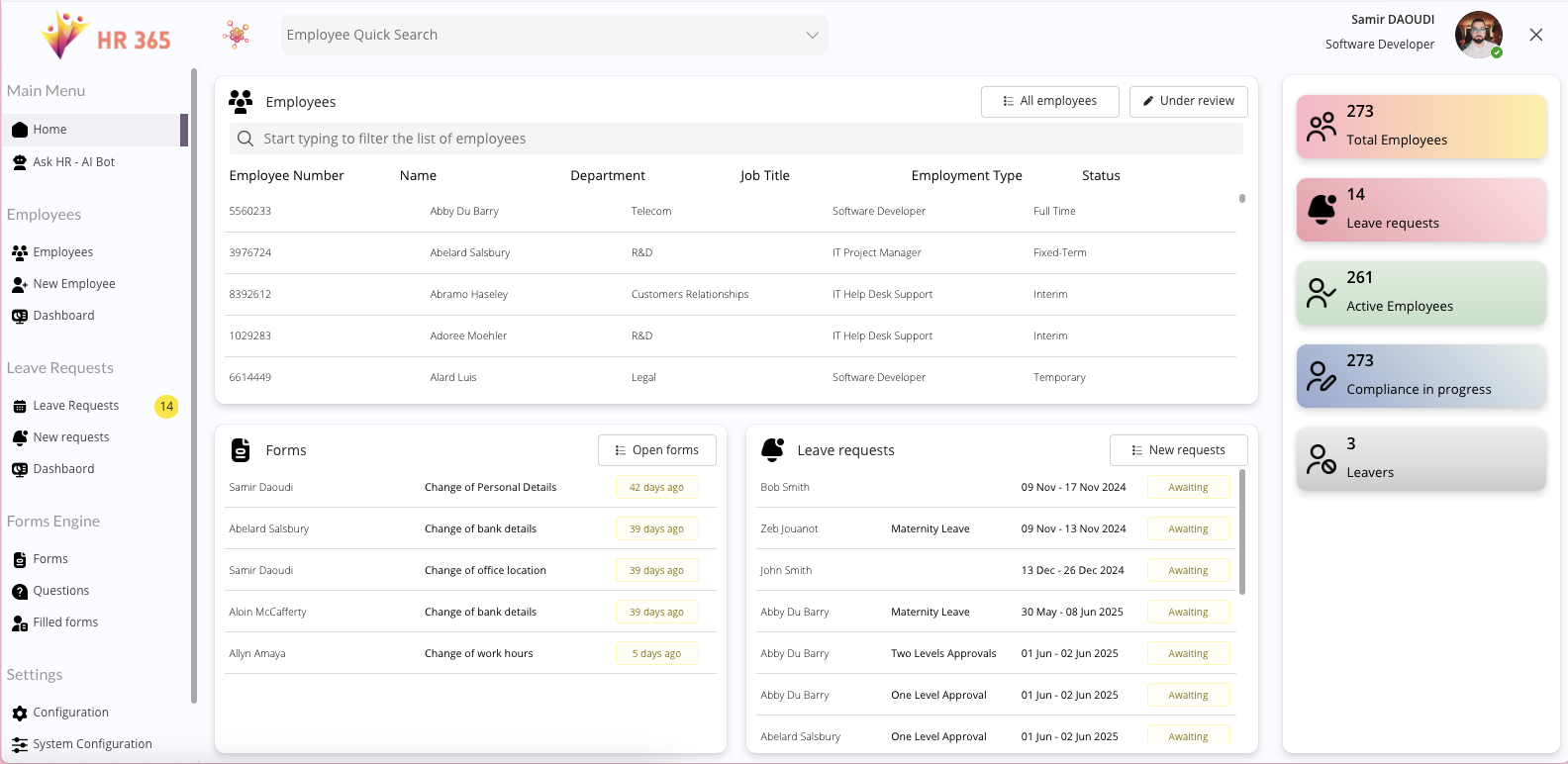
To make this concrete, consider what a solution like HR 365 delivers. Built entirely on Microsoft Power Platform and SharePoint, HR 365 provides a comprehensive suite that includes employee data management, leave and absence tracking, document storage, onboarding workflows, organizational charts, compliance controls, analytics dashboards powered by Power BI, and an AI-powered HR Copilot that answers employee questions using your organization’s own policies.

Because the entire system runs within your Microsoft 365 tenant, there is no separate login. Employees access HR functions directly through Teams or the web app. Managers approve leave with a single click. HR administrators get a unified view of the workforce without switching between platforms.

The AI Copilot is worth highlighting. Rather than employees searching through policy documents stored in SharePoint or sending emails to the HR team with routine questions, they can ask the Copilot directly. Questions like “How many annual leave days do I have left?” or “What is the parental leave policy?” get instant, accurate answers pulled from your own HR content. For UAE organizations managing multilingual teams across multiple emirates, this reduces the HR team’s administrative burden significantly.

The Data Ownership Advantage

This is the point that resonates most strongly with UAE decision-makers. With a Microsoft 365-based HR solution, your employee data never leaves your tenant. It is stored on infrastructure you control, governed by your existing Microsoft security policies, encrypted at rest and in transit, and subject to the role-based access controls your IT team already manages.

Compare this to a typical standalone HR platform where data is hosted in a shared multi-tenant environment managed by the vendor. If that vendor has a breach, your data is exposed. If they change their terms of service, you may have limited recourse. If you need to prove data residency for regulatory purposes, you are dependent on their compliance documentation rather than your own.

For organizations in the UAE that must comply with DIFC data protection regulations, federal data privacy laws, or international standards like GDPR, having full sovereignty over HR data is not a luxury. It is a requirement.

Who Is Making the Switch?

The businesses we see adopting Microsoft 365-based HR systems in the UAE tend to fall into three categories.

The first is SMEs that already run on Microsoft 365 and want to avoid the cost and complexity of onboarding a separate HR vendor. For a company with 30 to 200 employees, deploying an HR solution inside their existing Microsoft environment is faster, cheaper, and easier to support.

The second is mid-market companies that have outgrown spreadsheet-based HR processes but are not ready for an enterprise ERP like SAP SuccessFactors or Oracle HCM. They need a proper system but want it to be lightweight, customizable, and connected to the tools their teams already use.

The third is compliance-conscious organizations in sectors like finance, legal, healthcare, and government that cannot afford to store employee data outside their own infrastructure.

What to Consider Before Switching

Moving to a Microsoft 365-based HR system is not automatically the right choice for every organization. If your business requires deep WPS payroll processing or has complex multi-country payroll needs, you may still need a specialist payroll provider alongside your HR platform. The key question is whether that payroll system can integrate with your Microsoft 365 HR layer, and in most cases it can.

You should also evaluate the customization depth. One of the strengths of Power Platform-based HR solutions is that they are fully configurable. Absence types, approval workflows, onboarding tasks, document types, and compliance steps can all be adapted to your organization’s specific needs. But this flexibility requires either internal capability or a partner who understands both the platform and your business.


Getting Started

If your organization already runs Microsoft 365 and you are evaluating HR software options in the UAE, it is worth considering whether you actually need another standalone platform or whether the answer is already inside your existing environment.

HR 365 is built for exactly this scenario. It deploys inside your Microsoft 365 tenant, integrates with Teams, SharePoint, Outlook, and Power BI, includes an AI-powered Copilot, and gives you full control over your employee data.

HR365 microsoft partner - Logisam
HR 365 LogiSam

HR365 - Human Resources Management

HR365 Simple, Intuitive, and Seamlessly Integrated with Microsoft Teams, Powered by AI and Copilot. HR365, powered by Microsoft 365 and Copilot, provides a streamlined and intuitive experience for both employees and HR administrators. This solution leverages the capabilities of Microsoft 365 to enhance productivity, with Copilot offering intelligent assistance to users for greater efficiency.